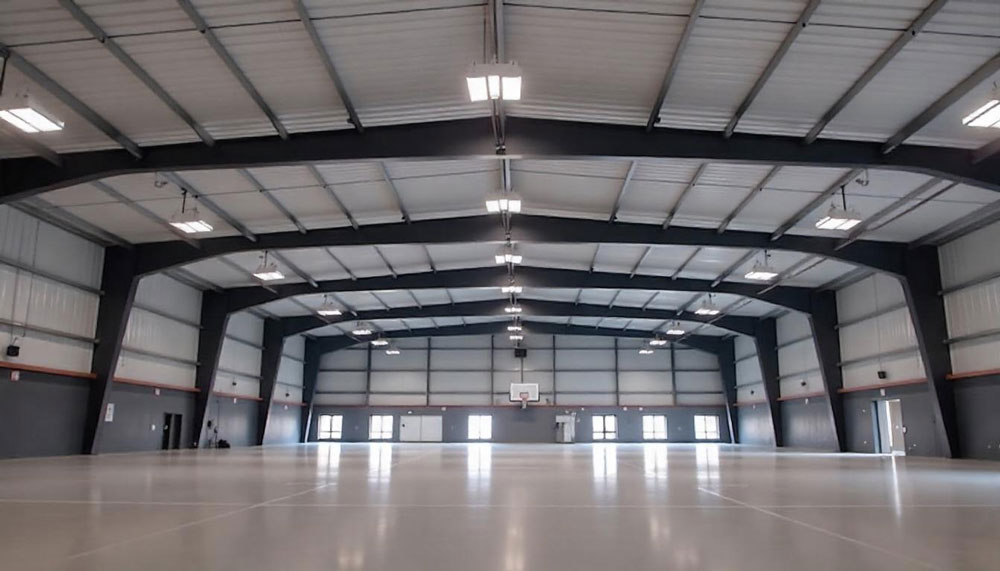
Imagine a sporting event where teams must dodge columns while running up and down the field. Or having tickets to an expensive theater performance, but framing creates a limited view. The open concept of these types of structure prevents these from happening.
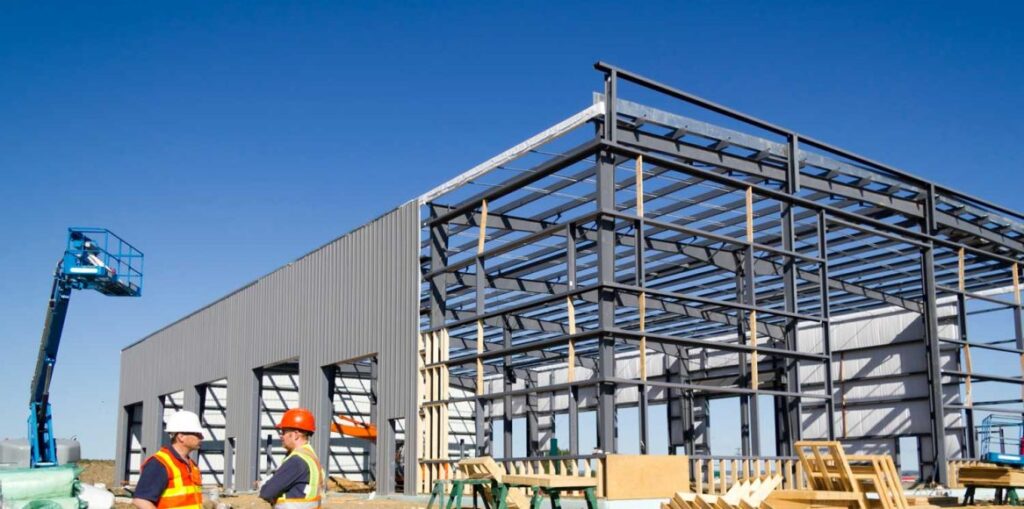
Clear span buildings provide unobstructed interiors from wall to wall throughout their length, making them ideal for retail, manufacturing, churches, arenas, and other facilities requiring expansive, column-free areas.
This article explains how CS buildings:
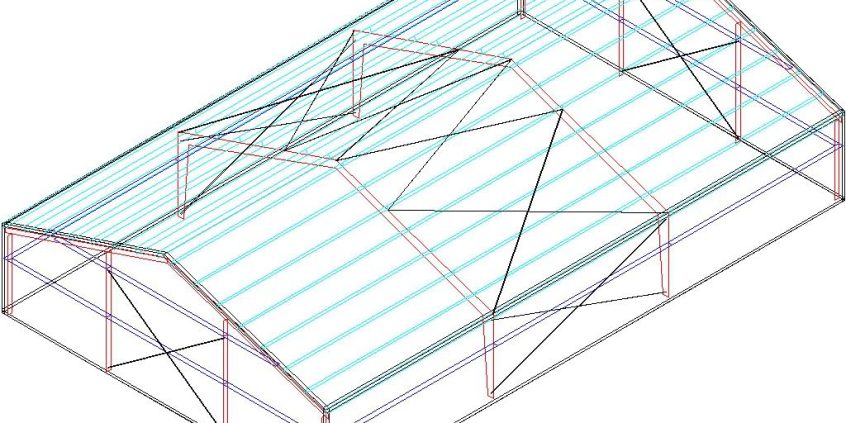
The width of a building from eave to eave is considered its span. Rafters of CS buildings extend all the way across the building and connect to the sidewall columns.
Clearspan doesn’t need interior load-bearing columns for support. As a result, the interior is free of obstructions throughout the building’s width and length.
Traditional structures have interior columns and sometimes interior walls that support the rafter framing. These additional components interfere with the usable interior area of the building.
Modern CS buildings can be engineered with massive trusses or arches spanning distances up to 300 feet without interior columns, creating unobstructed spaces ideal for aircraft hangars or sports facilities.
I-beam construction (such as structural steel buildings and PEMB buildings)features columns and rafters welded from individual steel plates to form an I-shape. Like an uppercase ‘I,’ an I-beam has three components: horizontal flanges at the top and bottom and a vertical piece called the web.
Steel beams fabricated with these three components are called rigid frames. The thickest plates are used in the areas with the highest load, making rigid frames very cost-efficient.
When the depth of these beams is uniform from end to end, the flanges are parallel, and the beams are called straight or prismatic. When frames are deeper at one end than the other, they are called tapered frames, and their flanges are not parallel.
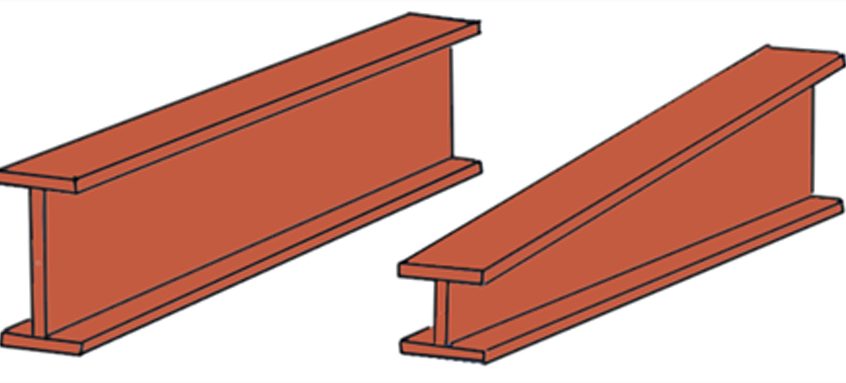
Straight and tapered steel I-beams
The tapered side of columns and rafters faces the interior of the building. The secondary framing supports the wall and roof cladding and attaches to the exterior facing flange. Tapered columns and rafters are deepest at their haunch connection near the eaves.
Clear-span buildings utilize tapered I-beams because of their cost efficiency and design flexibility. This type of structure benefits most from buildings requiring maximum floor space, such as office buildings, retail shops, warehouses, and others.
The maximum width of clear span structures is 300′. However, the most economical width is 40′ to 100′ wide. Standard roof slopes range from ½:12 to 4:12.
A tapered-beam system is commonly used when:
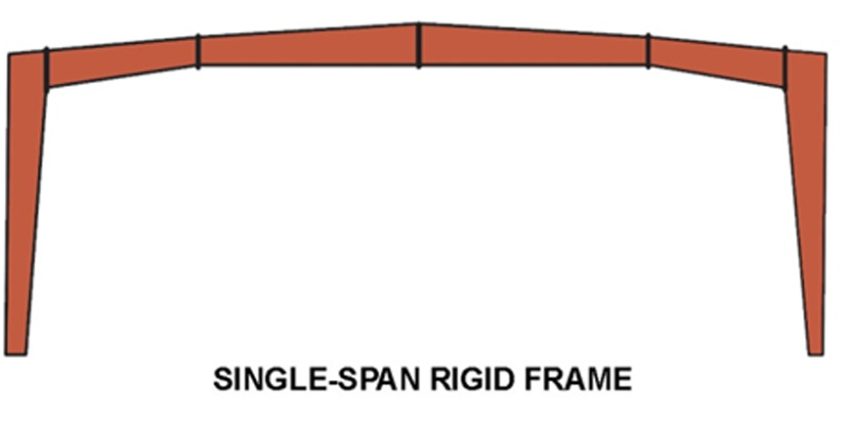
Single span rigid frame buildings have rafters that span the width of the structure and provide wide-open interiors the length and width of the building.
Indoor skating rinks, restaurants, sports arenas, warehouses, and factories benefit from rigid frame construction. As mentioned, these frames can be as wide as 300′.
Single span rigid frames can be classified as being:
This framing system is most commonly used when:
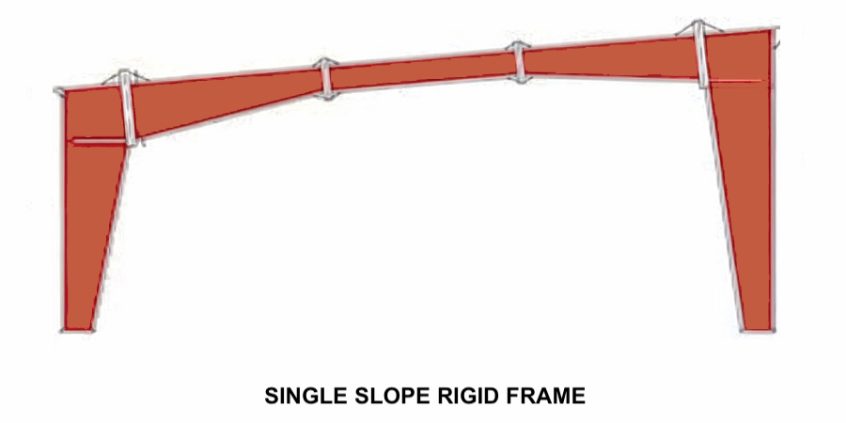
The “Single Slope” framing system is specifically designed for large buildings needing one-way roof drainage. Commonly utilized in retail stores, office complexes, and shopping centers, this framing style effectively manages rainwater runoff.
The frame members taper, with the deepest part at the knee—a critical joint where the beam meets the column. This system is popular for its cost-efficiency, requiring less steel than other structures with comparable spans and eave heights.
It’s proven particularly economical for spans of 60 to 120 feet and eave heights of 10 to 24 feet.
This framing system is widely used in applications needing large, unobstructed areas, such as gymnasiums, hangars, warehouses, and industrial facilities.
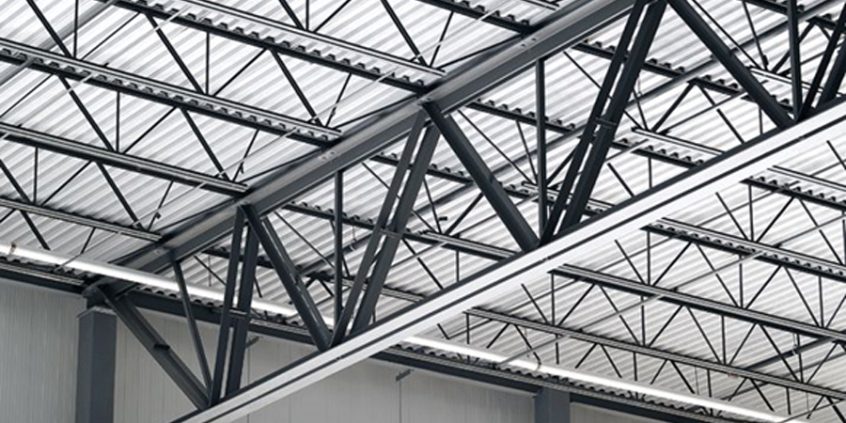
The next time you are in a large retail box store, look up. The framing you see and can literally see through is an open web truss system. Open web truss systems, often called joists, serve specific niches.
CS structures like big-box stores and large warehouses usually consist of concrete block walls, open web truss roof framing, and metal roof decking, which allows for straightforward and fast construction.
The trusses in this type of structure are lightweight but very strong. Flat connection areas, called seats, at each end, simplify installation. Seats allow the joists to rest naturally on top of frames while being welded or bolted in place.
Open web trusses also simplify HVAC and electrical conduit installation. These components are routed directly through the open webs instead of requiring bending and routing around.
Bridging is angle iron installed perpendicular to the trusses and parallel to the floor. It stiffens the joists and transfers diaphragm forces to the walls and footings. It’s essential that bridging and the open web trusses are connected securely to transfer the diaphragm forces.
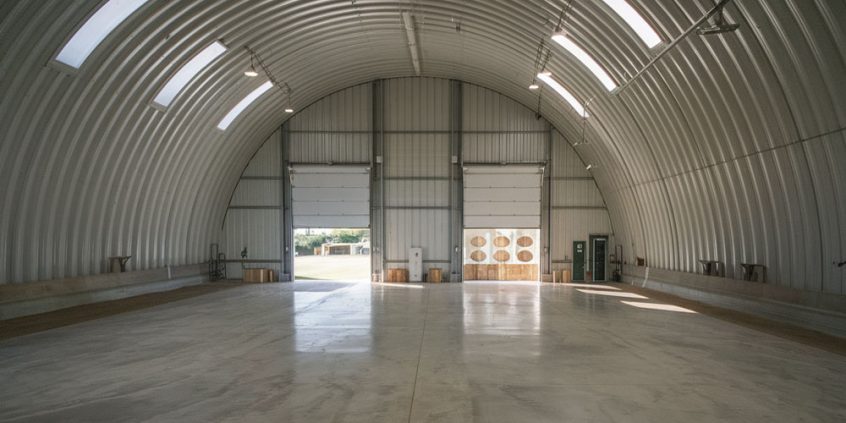
Quonsets, known for their semi-circular appearance, were introduced in World War I when the U.S. Navy needed easily transportable and assembled structures. These CS structures are named after the site of their first deployment, Quonset Point in Rhode Island.
Two-foot-wide, arched, corrugated panels bolted together along their edges supply structural integrity and cladding for the building. The ends are open but can be enclosed.
Arch buildings can be constructed with hand tools by as few as two people. They are available in widths from 12′ to 50′ and can be as long as needed.
The military used Quonsets as barracks, latrines, medical offices, and other housing. Today, they are homes, businesses, and storage facilities. They are also used extensively to store equipment, feed, and produce on farms.
See our Quonset hut section for further details.
Fabric buildings are clear span buildings with steel frames covered with stretched, heavy-duty fabric instead of steel cladding. They are durable and portable economical alternatives used for sports arenas, event venues, and agricultural buildings. The fabric can last up to thirty years.
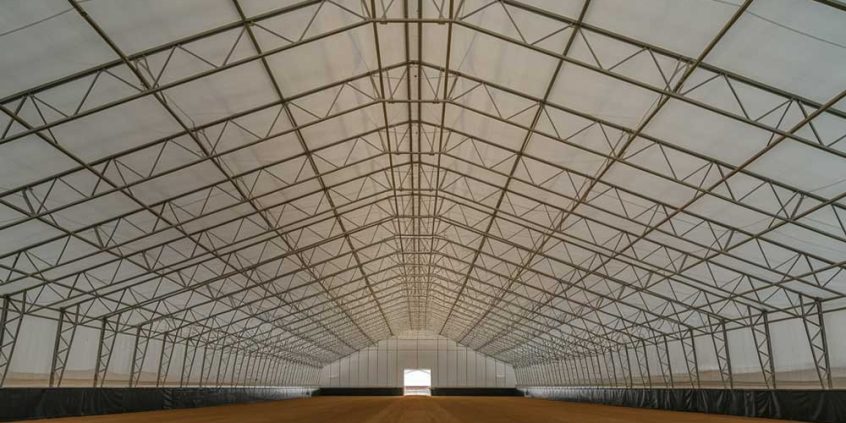
Fabric building interior
Another well-known type of clear-span metal building system is the cold-formed steel building.
Cold-formed steel (CFS) buildings offer cost-effective, lightweight, and durable construction solutions, ideal for various applications. Manufactured by bending thin steel sheets at room temperature, CFS components provide exceptional strength and versatility.
These structures are highly resistant to pests, rot, and fire, making them low-maintenance and long-lasting. CFS is also eco-friendly, as it is fully recyclable and supports sustainable building practices. Pre-engineered for precision, CFS buildings enable quick assembly and customization.
Their high strength-to-weight ratio makes transportation and handling efficient. Commonly used for warehouses, garages, and small commercial projects, CFS is a practical alternative to traditional steel and wood-framed buildings.
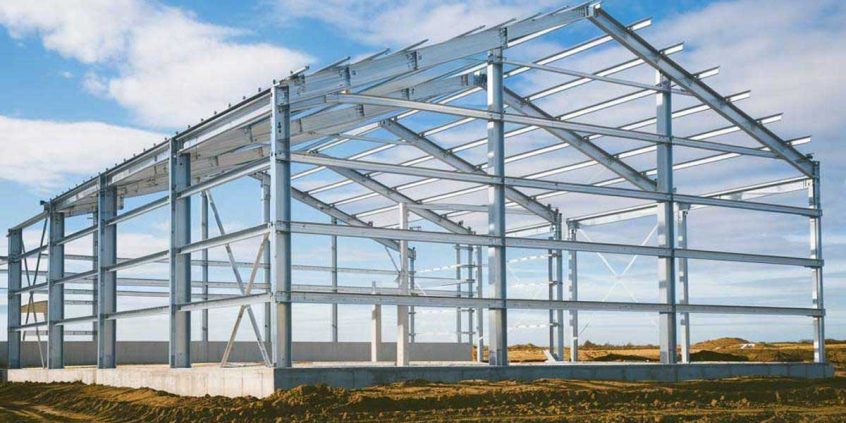
Clearspan construction provides open interior space from side to side and front to back of buildings.
Eventually, a building’s occupants move out, and new ones move in. Reconfiguring a CS building for new tenants is easy since there aren’t any interior columns. You can literally transform from manufacturing to retail use if needed.
CS steel buildings expedite construction because they are fabricated offsite and delivered as kits. No load-bearing interior columns mean no wasted interior area and fewer concrete footings to pour. In addition, steel requires little to no maintenance.
CS rigid frames can be spaced 20′, 25′, or 30′ on center for maximum floorspace. Eave heights range from 10′ to 60′, achieving vertical clearance needs. Single-sloped roof planes are also available.
Clear span construction enables unrestricted movement throughout the interior, maximizing efficiency and creating direct paths for both production facilities and office environments.
For more, see our article on the advantages of pre-engineered steel buildings.
Visualize your ideal structure with our intuitive metal building designer
CS steel buildings have higher initial costs for a couple of reasons. First, design and fabrication occur offsite but meet specific job site conditions, making them custom for that location. Next, steel costs more than wood and other framing materials.
Once a metal building kit is delivered, the higher initial costs begin normalizing. The kits arrive ready to assemble, which saves time and money. Steel requires little maintenance and has a long lifespan, which also saves time and money.
CS buildings are designed specifically for the location where they are being built. High wind or snow loads require design expertise to minimize the effects of deflection and other variables.
Their 300’ maximum span limit might challenge some projects. Regarding the width, some buildings have clearance requirements beneath haunches. As clear span frames get wider, the columns and rafters get deeper. The deeper frames can hinder clearances, creating design challenges or leading to taller eaves.
The open, space design allows spacious, unobstructed, durable storage for farm equipment, feed, and livestock. It also enables easier movement of equipment and livestock.
The wide-open design also works well for riding arenas and rodeo arenas. They are easily customizable to fit the comfort and needs of the sheltered animals or spectators in attendance.
CS structures provide wide-open floor space and vertical storage for warehouses and manufacturing facilities. The lack of interior columns means no obstacles to maneuver equipment around or impede the efficiency of production lines.
Pre-engineered metal buildings (PEMB) are the only ones that provide the most suitable aircraft storage facility and servicing space for modern aircraft hangars.
CS framing also complements the support and operational abilities of aircraft hangar doors.
CS buildings are practical solutions for sports and recreational facilities. Basketball arenas, skating rinks, swimming meets, and other athletic events require open spaces. With a clear view, spectators have an enjoyable experience.
Due to their open layouts, CS structures are perfect for retail and commercial purposes. The open plan allows flexible interior layouts for businesses, including showroom space for cars or other large items.
In recent decades, large, pre-engineered steel buildings have become a popular alternative to traditional small wooden churches. Prefabricated metal structures offer unobstructed views in sanctuaries and ample space for special events in the multipurpose rooms of modern churches and chapels.
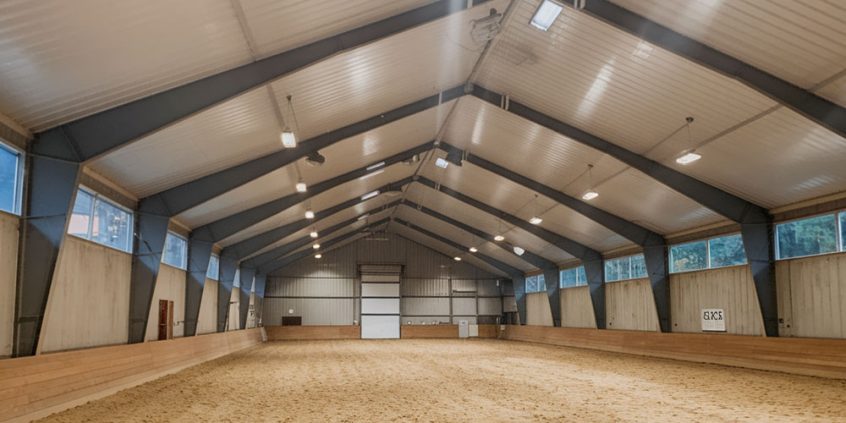
Wide-open riding arena interior
The cost of a CS building depends on its size, amenities, and location. Location plays a significant role, and here’s why.
Construction up north sees heavier snow loads. Buildings along the southern coasts are prone to high winds from hurricanes. Buildings located in the west have higher seismic loads, while those along the eastern coast have high snow and wind threats.
Prefab metal building kits cost from $15 to $25 per square foot.
Let’s explore how various components affect the pricing of popular building applications.
Agricultural facilities (barns, equipment storage )
There isn’t a more basic building than a farm storage building. They don’t need concrete floors and may not require electricity or walls. Let’s assume these cost savings result in the building kit costing $12-$15 per square foot.
Now, consider this same building used as a rodeo or equestrian arena. Spectators need seating, concessions, bathrooms, and maybe air conditioning. These features increase the cost of a basic building.
Aircraft hangars
Aircraft hangars have unique needs that affect their cost. Hangar doors are wide—around 40′ for a single door—and drive the building’s design. Folding, bi-folding, sectional overhead, rolling, and hydraulic doors are available.
The building’s framing supports the door. Some doors use wall pockets to hide them. Pockets add steel cladding, framing, and erection time to the cost.
High-lift or overhead doors require more headspace, meaning the eave height must be taller than required of other doors. Again, this affects the price. So does electricity, water, or other features owners may want.
Sports and recreational facilities
The basic building kit for a 200’x400′ building costs around $17 to $25 per square foot. These facilities have many interior features and amenities, such as large monitors, suspended speaker systems, bathrooms, seating, HVAC, and lighting.
Retail spaces and showrooms
Clearspan buildings used for retail are among the most straightforward to design and erect. They are a shell for aesthetically appealing freestanding shopping spaces inside.
They have sprinkler systems and rooftop units. Most have glass storefronts and facades for which the building provides structural support. All of these affect construction costs.
Places of worship
While traveling, you’ve probably noticed that modern churches are much larger and more complex nowadays. Their roofs have more than two planes, and their exterior finishes are works of art.
Underneath all this, one or more clear span structures provide the bones for these churches. The bones support large projection screens, partitions, speakers, and other accessories. Electronics, accessories, and aesthetics affect price.
Refer to our metal building prices page for more details.
CS construction is the most economical and innovative building solution. Manufacturing facilities utilize sustainable materials, like recycled steel, for steel coils and plates.
New materials like transparent cladding and fabric coverings reduce energy by providing natural lighting. Both are lightweight but durable and heavy enough to maintain indoor comfort.
Designers today use BIM and other 3D technologies to visualize and address potential issues before fabrication, saving time and money by eliminating surprises later.
Research
Before making a decision on your building solutions, talk to your local steel building suppliers. Your local clear span steel building company will assist you in getting the right building kit for your needs and with location-specific pricing.
While most products are similar, suppliers offer different building kits and customization options. So do your due diligence and compare apples to apples – or should I say, steel to steel.
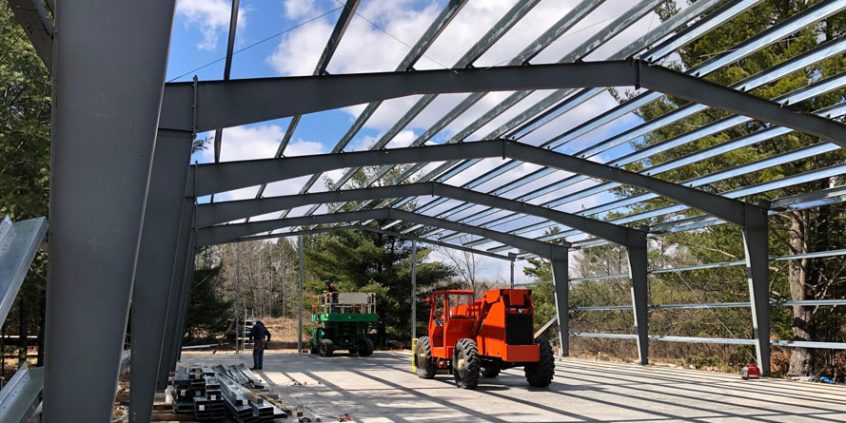
Clear-span buildings solve construction needs with their flexibility, adaptability, and affordability. For example, they are the only buildings that can begin as retail shops and later become indoor skating rinks if needed.
The steel building kits arrive at the job site already cut to length and bolt holes drilled. These kits expedite construction time.
Steel buildings save money on labor and reduce noise and waste on the job site. Perhaps the best part is that they require very little maintenance.
Let us help you find the best building solution for sale ……
To learn more about how a red iron building can work for your project or to receive personalized quotes from four leading suppliers, our team is ready to help you find the best solution from our network of trusted manufacturers.
For a comprehensive list of PEMB terminology, see our steel building glossary page.
Steel building manufacturers each have standard building sizes, but buildings can usually be up to 300′ wide without special engineering. The most popular and economical width is 40′ to 100′.
While the building width is limited, it can be as long as needed. AT&T Stadium, the home of the Dallas Cowboys, is a clear-span building covering 73 acres. It has a huge retractable roof consisting of two sections measuring 256′ by 410′.
A CS building’s rafters span their entire width and connect to sidewall columns. The area between is completely open for maximized use.
Multi span buildings utilize interior load-bearing columns to help support their rafters. In addition to the columns at the ends of the rafters, they have one or more load-bearing columns spaced across the width of the building.
The cost of constructing a commercial building can vary significantly due to many factors. This introductory article explores the key
There are several factors that can greatly affect the cost of constructing a modern warehouse facility. These include the location,
Let’s start with a quick look at the somewhat confusing terminology surrounding both construction options. Poles Barns – AKA: pole
BuildingsGuide simplifies the process of finding reputable suppliers of prefab metal buildings, allowing you to select the ideal vendor for your needs and budget.
Since 2004, over 200K buyers have saved an average of 28% on their project with our multiple quote service.
Proudly serving customers in the United States & Canada for over 20 years.
Let us help you find the best deal on a metal building for sale.
BuildingsGuide offers a full range of custom metal buildings throughout the USA and Canada. Our metal building kits include garages, workshops, metal homes, shop houses, and other steel buildings. For metal and steel building kit packages, there’s no better partner than BuildingsGuide. Depend on us for customizable steel and metal buildings with fast delivery and limited installation nationwide.