Let’s start with a quick look at the somewhat confusing terminology surrounding both construction options.
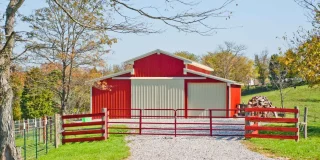
Poles Barns – AKA: pole buildings, metal pole barns, pole sheds, and post-frame buildings.
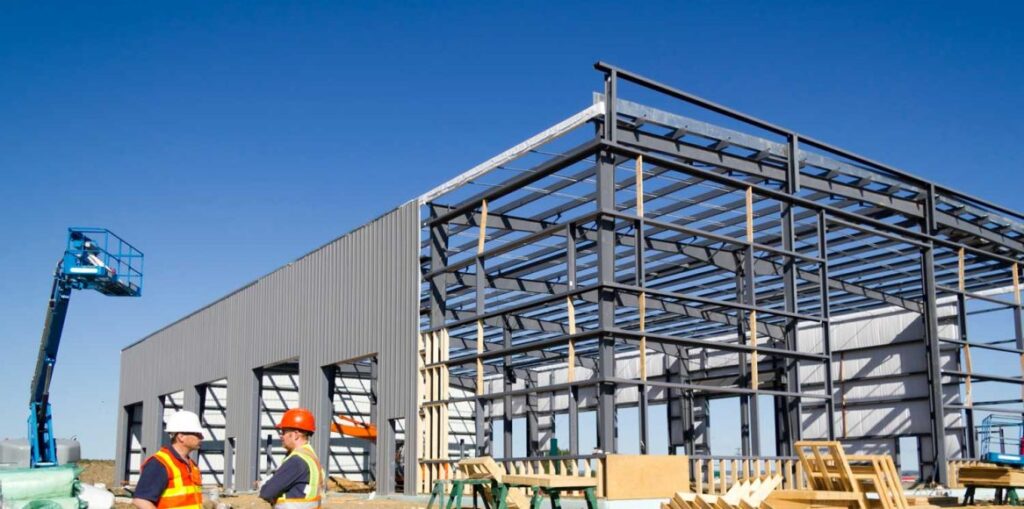
Metal Buildings – AKA: steel buildings, pre-engineered buildings, prefab buildings, and red iron buildings.
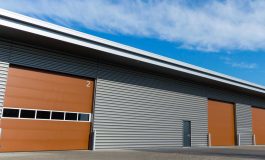
Also, as both building options generally have metal siding and roofing, it is easy to confuse the two from the outside.
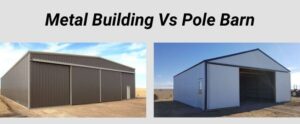
Here’s a quick overview of these two popular construction options, followed by a more detailed look at how they differ.
Pole barns are buildings made of wooden frames that are screwed and nailed together, while metal buildings are constructed using solid steel frames that are bolted together on-site. Typically, both types of building kits are delivered with steel panels for siding and roofing.
While pole barns have a lower initial cost than metal buildings, investing around 15% more in a steel structure can result in long-term savings through reduced maintenance expenses and lower insurance premiums of 30% or more.
Additionally, opting for a metal building offers the benefits of a highly durable building with a warranty of up to 40 years that adds value to your property.
Wood Vs. Metal Construction
Although they look very similar from the outside, the real difference is apparent once you step inside. As you can see from the photos below, a pole barn has traditional wooden framing compared to a metal frame red iron building with all steel construction.
What is a Pole Barn?
A pole barn is a type of agricultural outbuilding constructed using wood framing supported by poles or posts driven into the ground. They are typically used to house livestock, hay, farm equipment, and other agricultural supplies. Pole buildings are economical and easy to construct, making them an attractive option for small farms, ranches, and homesteads requiring additional storage space.
What is a Metal Building?
Metal buildings are structures comprising of solid steel framing components precision-engineered in modern manufacturing plants. They are known for their durability, strength, and resistance to the harshest environments. Metal-framed buildings are commonly used for commercial, industrial, agricultural, and, more recently, residential homes.
Pros & Cons of Each Construction Method
Let’s take a look at some of the key benefits and drawbacks of each building option.
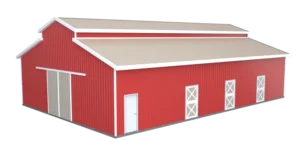
Which is Cheaper a Pole Barn or a Metal Building?
You’ll be pleased to hear that there’s not much difference in price.
Here are some average costs for each construction option. Please note your final cost will depend on your location and options such as doors, windows, skylights, and insulation.
For additional pricing, see our steel building cost estimator.
Why Buy a Metal Building over a Pole Barn
Although pole-building kits are a great choice for those looking for a simple, no-frills structure, there are several reasons why (if your budget allows) you should strongly consider a metal-framed building.
Strength & Durability
Pole buildings and steel structures use different framing materials. Wood is cheap and easy to use but can be damaged by weather, fire, and pests. Steel is strong, durable, and needs little maintenance.
As the poles/columns for a pole building are buried in the ground, they can shift over time and must be straightened periodically.
Weather Resistance
Due to the nature of wood and the screw/nail connections, pole buildings struggle to offer a completely weatherproof building. A metal building with engineered framing and securely bolted connections offers a completely sealed and watertight building envelope.
Safety & Security
Wooden pole structures use chemically treated wood that can be poisonous to livestock and can’t be recycled.
Steel is non-combustible by nature and provides a safe environment for its inhabitants.
Metal-framed structures are engineered to resist the harshest environments and meet all local building codes.
Savings Insurance & Maintenance
Due to the fire resistance of steel, insurance premiums can be up to 30% cheaper.
Steel buildings require virtually zero maintenance as opposed to pole structures that require painting and maintenance over time.
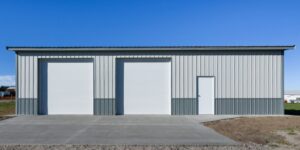
Key Differences Between a Pole Barn & Metal Barn
Design & Construction
Pole barns and metal buildings are erected using very different construction methods.
Post-frame buildings use wooden poles as framing, anchored into the ground, with 8 to 12 feet spacing. Metal buildings use pre-engineered steel I-beam columns anchored to a concrete foundation, with 20 to 30 feet spacing. This allows more flexibility in door placement and creates separate modules called bays.
Pole buildings are often not designed to meet local building codes because there is no prescriptive building code for pole buildings. On the other hand, steel buildings are designed to meet local codes for wind, snow, and seismic loads.
Pole barns and steel buildings are sold as DIY or professional construction kits. However, it is recommended to have prior construction experience for DIY, and for buildings larger than 3,000 square feet, it is advisable to hire a local construction crew.
Foundations
Pole barns typically use a post-frame foundation consisting of wooden poles anchored in the ground, either driven directly into the ground or supported with concrete footings.
In contrast, steel buildings require a concrete slab foundation or a pier and beam foundation to securely anchor the building to the ground. Again, similar to the engineered mainframe, steel building foundations are engineered to meet all local codes.
A solid foundation is crucial for the longevity and stability of any building, and choosing the appropriate foundation for a pole building or metal building will depend on factors such as budget, soil conditions, and building usage.
Where are Metal & Pole Structures Built
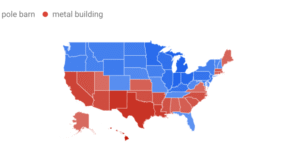
As indicated earlier, pole barns are extremely popular as farm and agricultural buildings. To illustrate this, take a look at the maps below that clearly show that these structures are still popular among farmers and ranchers in the United States.

A Brief History of Pole and Metal Structures
Peter Norris developed the first steel buildings in 1848, which were nicknamed “iron houses” and sold to fortune seekers during the California Gold Rush. In 1909, Butler Manufacturing Company created the first pre-engineered metal buildings (PEMB) to provide garaging space for the Model T Ford.
Pole barns have a long history, dating back to the 1930s depression era when farmers in the United States first used them using decommissioned utility poles. The design was simple and cost-effective, allowing farmers to quickly and easily construct buildings to store equipment and livestock

For current discounted prices, visit our metal buildings store