- /
- Metal Building kits
- /
- 60×100
60x100 Metal building - Cost guide, custom kits and pitfalls to avoid
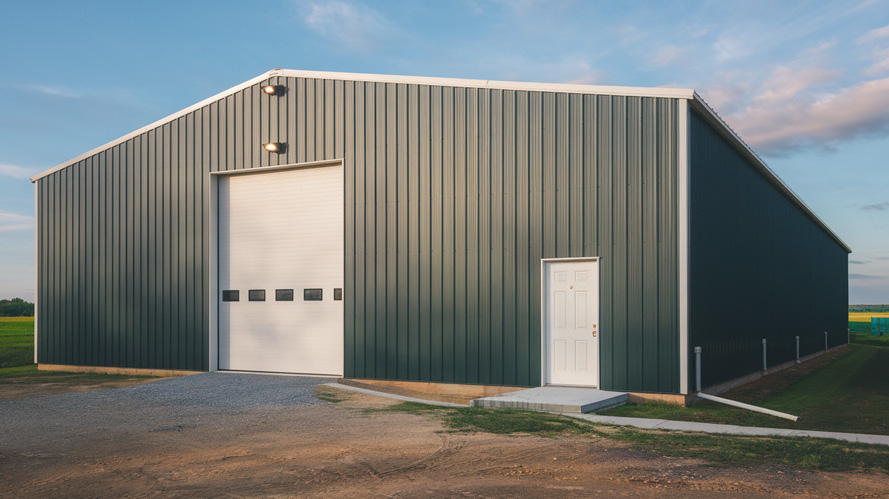
Building kits using prefabricated solid steel components are more cost-effective and faster to construct than traditional wood or concrete methods. A 60 x 100 steel building (6,000 square feet) is an ideal solution for storage barns, office warehouses, and modern homes and shop houses.
- Made in USA
- Solid Steel
- 30 Yr Warranty
- Custom Engineered
Get Four Quotes
Compare prices from local suppliers and save
Popular products
Here are some of our most known standard height options for our 60×100 building kit products. Please be aware that a two-foot gap is required from the eave to the top of the tallest door (e.g. a 10′ door will require a 12′ eave height).
For floor plans and layout ideas, see our sample metal building plans.

Features of a 60x100 steel building kit
Standard 60×100 building kits come with primary and secondary framing, wall panels, a metal roof, and sealants. But you can tailor the building dimensions, window placement, and door placement to fit your needs.
Kit packages include:
- Steel I-Beam framing
- Steel roof & wall panels (26ga)
- Complete trim package
- Two framed door openings
- Foundation anchor bolt plans
- Engineer stamped plans
- Kit package delivery
- Installation instructions
- All bolts, flashing & sealants
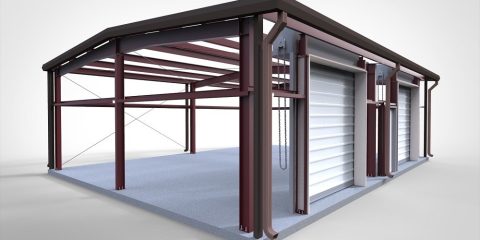
I-Beam framing
Benefit from:
- Bolt-up construction
- Trussless roof design
- Clearspan widths to 300′
- Certified to 160 MPH wind
- Certified to 110 PSF snow
- 30+ year warranty
- Fast, free delivery
- Fast build time
Custom options:
Doors – “Choose overhead doors, rollup, sliding, or bifold doors for your metal garage or building.
Roof profile & pitch – Adjust the gable roof pitch or select a single-slope, gambrel, or monitor profile
Insulation – Opt for vinyl-faced fiberglass, spray foam, or insulated metal panels (IMPs).
Structural upgrades – Add porches, overhangs, a carport lean-to, or a mezzanine for loft storage in your garage.
Items not included:
- Permits
- Foundation
- Installation
- Insulation
- Interior build out
How much does a 60x100 metal building cost?
The cost to build a 60×100 metal building ranges from $25 to $85 per square foot, including the building kit package, delivery, and installation, with an average turnkey cost of $198,000. Your final cost will vary depending on location, design complexity, and the level of customization required.
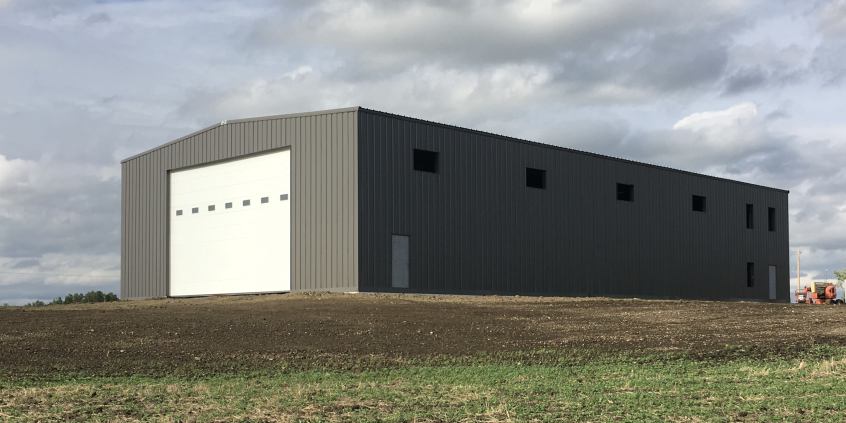
60 x 100 steel building
Cost breakdown for a 60x100 metal building
Here is an expenditure breakdown for a standard 60×100 building with a concrete slab foundation and no interior build-out.
| Cost factor | Total cost (Avg.) | Cost / square foot (Avg.) |
|---|---|---|
|
Metal building kit |
$96,000 |
$16 |
|
Site prep & foundation |
$48,000 |
$8 |
|
Construction |
$42,000 |
$7 |
|
Accessories |
$12,000 |
$2 |
|
TOTAL |
$198,000 |
$33 |
Costs associated with each stage of construction are explored in the sections below.
Land cost estimates
This is one of the most challenging estimates for any project, as land values vary widely from coast to coast.
For a 6,000-square-foot building, you’ll need a minimum of approximately 0.5 acres (22,000 sq ft) of suitable land. This will allow adequate access, parking, and setbacks (or yard space for residential builds).
Based on current nationwide averages, here are some typical costs for a half-acre building plot.
| Land type | Price range (0.5 acre) |
|---|---|
|
Agricultural / Farm |
$725 to $4,050 |
|
Industrial / Commercial |
$25,000 to $200,000 |
|
Residential |
$110,000 to $440,000 |
Please note your land-to-building ratio will largely depend on local land use and zoning laws.
On average, industrial land in the United States costs $117,951/acre, with prices ranging from $25,000 to $200,000 for a half-acre industrial plot.
According to the most recent USDA figures, the national average for agricultural and farmland ranges from $1,450 to $8,100 per acre.
Building design costs
For most projects, the design services of your chosen building supplier will enable you to customize the structure without requiring an architect.
Alternatively, if a more elaborate design is required, you should budget for one or more of the following:
- Architect fees at 7% to 15% of the construction cost.
- Interior designer fees from $700 to $5,000.
- For residential shop houses and barndominiums, floor plans can run from $750 for a stock plan to $2,000 for a fully customized one.
Cost of a 60x100 building kit
The average cost for a pre-engineered 60 x 100 steel building kit package is $96,000.
This will vary depending on where the building will be erected, as the frame must be engineered to meet local codes for wind, snow, and seismic activity. It will also fluctuate depending on the structure’s required height.
Our building kit packages sold by our suppliers are shipped with all the necessary components to construct your building, including:
- Primary framing components (columns, beams, and rafters).
- Secondary framing components (roof purlins, wall girts, struts, and bracing).
- Metal wall and roof sheeting panels.
- Fasteners, sealants, and an erection manual.
Roof-only steel buildings are also an option and are typically used as large hay barns, outdoor gymnasiums, carport parking structures, and horse riding arenas.
Such structures can be 25-35% less costly than a fully enclosed building because they don’t require wall girts or wall panels. The average cost for a roof-only 6,000-square-foot building is $138,000.
Site prep and foundation costs
Before a foundation can be installed, the site must be cleared and prepared for construction.
Site prep costs vary widely. A 6,000-square-foot site can range from $3,800 to $26,000, broken out as follows:
- Soil testing and analysis $700 to $1,800.
- Site clearing $780 to $12,000 ($0.13 – $2/sq ft).
- Land leveling and grading $2,400 to $12,000 ($0.4 – $2/sq ft).
Costs will be dictated by:
- The condition of the site (removal of existing structures, trees, etc.).
- The amount of grading required.
- Soil quality.
A concrete foundation for a 60×100 metal building costs from $6,000 to $68,000.
Depending on the end use of your 60×100 steel building, you may require a concrete slab foundation.
If you plan to store heavy machinery or equipment, then a six-inch foundation is required to handle the additional load. A four-inch foundation will suffice for everything else.
However, most dirt-floor agricultural buildings only require concrete piers to support the structure. The size of those depends on soil type and the weight of your building.
The number of piers required for a typical 60×100 building (with 25-foot bay spacing) is 12 to 16.
All new builds (irrespective of end use) require concrete piers to anchor the steel columns to the ground.
The cost of an engineer-designed and stamped foundation plan must also be factored in. These typically run anywhere from $3,000 to $6,000, depending on complexity and type.
| Foundation Type | Cost per Square Foot | Total Cost |
|---|---|---|
|
Slab foundation (4”) |
$5 – $7 |
$30,000 – $42,000 |
|
Slab foundation (6”) |
$8 – $10 |
$48,000 – $60,000 |
|
Concrete piers (min. 12) * |
Min $500 (per pier) |
$6,000 – $8,000 |
* This is a rough estimate. A structural engineer will advise on the required number of piers based on calculations specific to your building and location.
Construction costs
Constructing a metal building costs between $5 and $10 per sq. ft., so $30,000 to $60,000 for a 60×100 metal building (based on constructing a standard rectangular building with no complex design upgrades).
If opting to self-build, be sure to hire a company with plenty of experience working with pre-engineered buildings (not all companies do).
For a building of this size, we strongly recommend hiring a General Contractor (GC). The GC will hire, manage, and oversee all the necessary subcontractors and ensure the project runs smoothly. GCs typically charge from 10 to 20% of the construction cost.
Custom accessory costs
A standard building must be customized to suit your intended application. Some of the more popular custom options include:
Doors and windows
During the design stage, the number, size, and placement of doors and windows must be specified. Framed openings are then engineered at the factory to accommodate them.
| Opening Type | Framed Opening Cost | Door Cost | Total Cost |
|---|---|---|---|
|
Commercial garage door |
$400 – $800 |
$900 – $4,000 |
$1,300 – $4,800 |
|
Commercial roll-up door |
$400 – $800 |
$1,200 – $5,000 |
$1,600 – $5,800 |
|
Personnel door |
$300 – $600 |
$450 – $850 |
$750 – $1,450 |
|
Windows (4’x3’) |
$200 – $400 |
$200 – $700 |
$400 – $1,100 |
Framed openings
Insulation
When it comes to insulation, there are two primary options: closed-cell spray polyurethane foam (SPF) and fiberglass blanket (or batts).
The cost for 2-inch (R-12) SPF insulation is $18,800 and $33,750 (based on an installed price of $2.5 – $4.5/sq ft), while 4-inch (R-13) fiberglass blankets will cost $5,300 to $18,750 (based on an installed price of $0.7 – $2.5/sq ft).
We recommend SPF insulation for its numerous benefits, including:
- Higher R-values with less material.
- Exceptional thermal barrier due to air-tight seal.
- Increased structural integrity and building rigidity.
- Superior moisture resistance and waterproofing capabilities.
- Greater durability than other insulation types.
Additional custom features/costs include:
- Lean-to extensions from $24 to $26 per sq ft.
- Door canopies (awnings) from $850 to $2800
- Ridge vents (installed) from $350 to $750 (9” x 10’).
- Turbine vents (installed) from $150 to $300 per 16” vent.
- Cupolas from $500 to $1,200 per 3’x3’ cupola.
- Gutters and downspouts spaced at 25’) from $2,520 to $5,400 (based on an average of $7 – $15 per linear ft).
Utility installation costs
Depending on the location, you will either tie into existing utilities or run new service lines to the site.
- Electricity hookup will cost $10 to $25 per foot (from the nearest line).
- Utility pole installation will cost from $350 for a temporary pole to $10,000 for a permanent one with 500 feet of underground wiring, transformer, and meter box.
- Water lines will run anywhere from $1,200 to $10,000 (the nationwide average is approximately $3,750).
- Drilling a water well with a completely installed system will cost between $5,000 to $10,000.
- Sewer lines will cost an average of $3,000 to $6,000.
- Septic installation can run anywhere from $3,500 to $12,000.
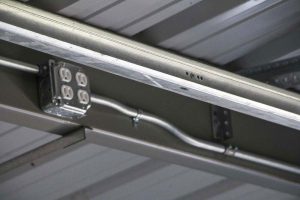
Interior build-out costs
If required, the interior of a pre-engineered building can be framed and finished much like a traditional building. Interior rooms and partitioned areas are framed with either wood or steel studs. The final expenses for the interior build-out will be dictated by square footage and the level of finish work.
- Interior framing will range from $20 to $30 per square foot for steel studs and approximately $8 to $16 per square foot for traditional wood framing.
- Interior finishing costs for drywall, paint, and trim will fall between $5 to $9 per square foot.
- Electrical wiring for outlets and lighting will cost $3 to $7 per square foot.
- Plumbing costs will fall between $4 and $6 per square foot.
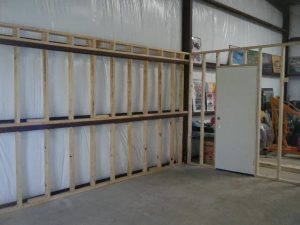
Interior framing
How do we compile our data?
We work closely with our broad network of building suppliers, manufacturers, and installers, compiling the latest cost trends. Our writers and fact-checkers conduct thorough research, referencing sources like Craftsman and RSMeans, for up-to-date construction data.
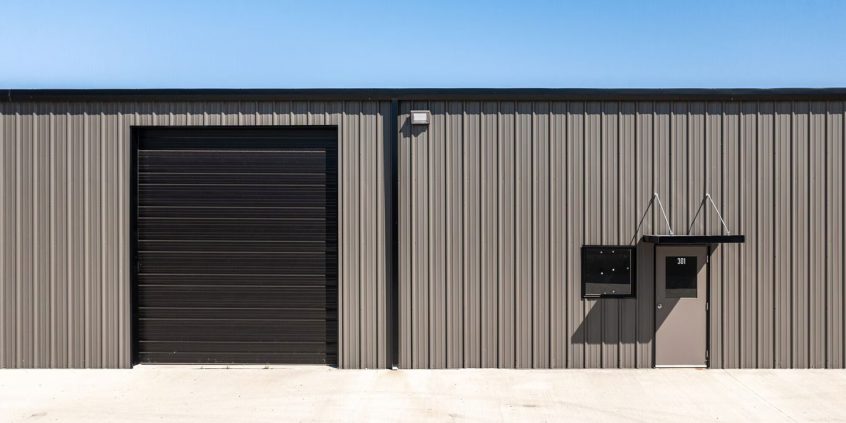
Industrial 60×100 steel building
Frequently asked questions
Are steel buildings energy-efficient?
Yes, they are. Unlike wooden structures that can develop gaps over time, steel buildings don’t warp or settle, thus providing an air-tight building envelope. Their energy efficiency can also be improved with reflective metal roofs (cool roofs) that decrease cooling costs by up to 40%. These also allow for effective temperature regulation. Utilizing insulated panels and specialized systems also plays a role in maximizing energy performance.
Should I insulate my building?
Whether you need insulation depends on how you’ll use the space, such as turning it into storage facilities. If you’re housing heat-sensitive equipment or will have people or animals inside, consider the thermal conductivity of metal. The building may experience severe temperature fluctuations without insulation, becoming excessively cold in winter and uncomfortably hot in summer.
How long do metal building kits last?
They typically last 50 to 100 years, with variations depending on material quality, environmental conditions, maintenance, construction quality, and usage. Advances in technology continue to enhance the durability and lifespan of PEMBs. Regular maintenance and high-quality materials can significantly extend their longevity.
Do I need building permits to build a steel structure?
Generally, yes, you’ll need a building permit to get a metal building approved by your local building department. However, you might be exempt if the structure is for farming purposes. Before starting a project be sure to consult with your local building department.
How many square feet is a 60x100 building?
A 60×100 building is theoretically 6,000 square feet wide. However, the actual usable space can vary depending on the intended application. Structures with internal rooms and partitions will have less usable floor space. If you have in-depth questions, you can call by phone or email our team for expert guidance.
Further Reading
The cost of constructing a commercial building can vary significantly due to many factors. This introductory article explores the key
Let’s start with a quick look at the somewhat confusing terminology surrounding both construction options. Poles Barns – AKA: pole
There are several factors that can greatly affect the cost of constructing a modern warehouse facility. These include the location,
Why choose us?
BuildingsGuide simplifies the process of finding reputable suppliers of prefab metal buildings, allowing you to select the ideal vendor for your needs and budget.
Since 2004, over 200K buyers have saved an average of 28% on their project with our multiple quote service.
Proudly serving customers in the United States & Canada for over 20 years.
Compare & save!
Let us help you find the best deal on a metal building for sale.
- Tell us about your project
- We match you with vetted suppliers
- You receive four competing quotes
- Select the most suitable supplier
- Start your project